Common fault identification of electronic expansion valve and four-way valve
1. Four-way valve
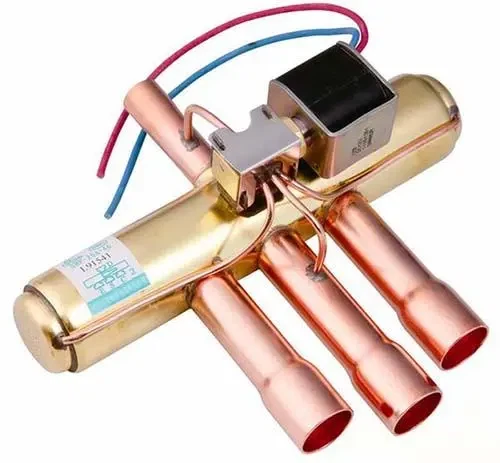
The four-way valve, also called the electromagnetic four-way reversing valve, is an important component of the air conditioning system and mainly plays the role of switching between cooling and heating. For four-way valve cross-gas diagnosis, please refer to the following.
1. "Touch": Whether in cooling or heating mode, cross-air means that the suction pipe that should be cold is not cold, and the exhaust pipe that should be hot is not hot. Temperature testing instruments can be used to measure the temperature difference between suction (5~15 degree in rated refrigeration mode) and exhaust (60~90 degree in rated refrigeration mode); if the error is not obvious, it indicates cross-flow of the four-way valve. If there is no temperature measuring instrument, You can judge by "touching" with your hands.
2. "Listen": When working, gently turn the coil and listen for "squeaking" electromagnetic noise, which means there is basically no problem with the electromagnetic coil. If there is no obvious reversing pull-in "bop" sound when reversing, it indicates that the four The valve may be stuck. You can tap it gently with a small wooden stick to see if it can be restored.
3. Coil diagnosis method - "test": Usually the power supply voltage of the solenoid coil of the four-way valve is AC 220V power supply. You can first measure whether the voltage at both ends of the coil is normal, and then use a multimeter to see whether the resistance of the solenoid coil is normal.
2. Electronic expansion valve
Normal electronic expansion valve: There is a "clicking" sound after plugging in. If there is no sound, or the expansion valve begins to frost after the compressor is working during cooling, you should check whether its coil and power supply are normal (12V pulse electricity). If the voltage is normal, it means the computer board is normal. If there is no sound in the expansion valve at this time, the expansion valve is defective. At this time, first measure the DC resistance of the electronic expansion valve coil. If it is normal, the internal organs of the valve body may be blocked. High-pressure gas can be used Perform purging.
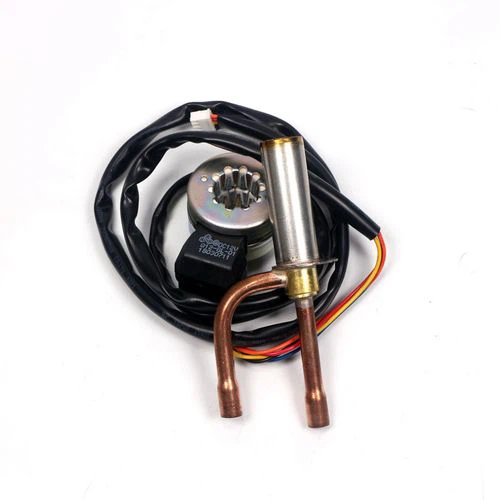
1. The electronic expansion valve is in a fully closed state.
Analysis and maintenance: Normally, before the electronic expansion valve is powered on, the needle valve is in the open position. When the valve body leaves the factory, the valve opening is 480 pulses. However, since the rotor is fixed through a threaded structure, the position of the rotor may change due to vibration during transportation, eventually leaving the valve in a fully closed state. When encountering this fault, just perform a reset operation after powering on to ensure that the valve body is in an open state, so that the needle valve opening can be controlled by the stepper motor to adjust the flow rate.
2. After starting up, there is noise in the electronic expansion valve.
3. The electronic expansion valve does not operate.
Analysis and maintenance: When turning on the power, first listen to whether there is a "click" sound in the valve body. If not, check whether the valve body is completely inserted into the coil, whether the connection between the coil and the circuit board is normal, and whether the coil power supply voltage meets the requirements (12V± 1.2V). If the above inspections are normal, check whether the valve body can be fully opened. If not, it means that the valve body is damaged and needs to be replaced. If the valve body can be fully opened, check whether the pulse number of the valve fully closed is greater than 480pps. If it is lower than 480pps, check the driving mechanism.
4. The electronic expansion valve is stuck.
Common debris include foreign matter in pipelines, welding oxides, etc., that is, failures are mostly caused by humans. In order to prevent this failure, the first is to enhance the cleanliness of the pipeline during maintenance, the second is to adopt welding protection, generally by filling with chlorine to reduce oxides, and the third is to install filters with a mesh size of more than 100 on both ends of the valve body. .
When welding the electronic expansion valve, the valve body should be completely immersed in water and filled with nitrogen for protection during welding. In order to prevent the filled nitrogen from being heated into high-temperature gas and passing through the valve core and damaging the electronic expansion valve, the nitrogen must be discharged from the expansion valve. The import and export are charged at the same time.